Frank Spring
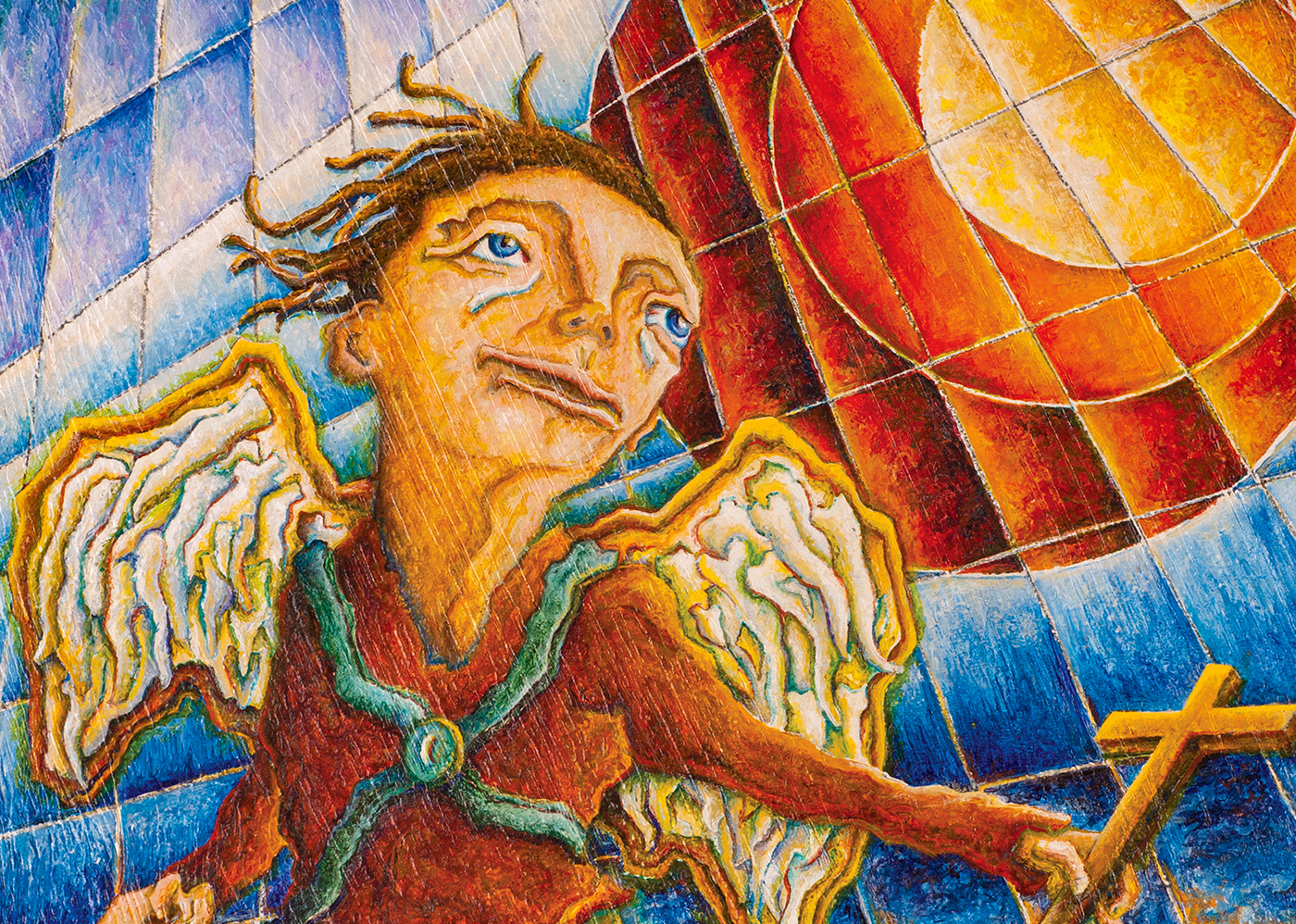
The Aspirant
In “The Aspirant” Frank depicts himself as an angelic figure floating against a backdrop resembling an abstract classical-style sunset or dawn. The sky in the painting isn’t a seamless expanse but rather a reflection, like light passing through a skyscraper’s windows or a church’s stained glass. It exudes a sense of hard geometry rather than free-flowing beauty. In the artwork, Frank’s eyes are filled with tears, and he holds a cross.
Frank paints himself as elevated above unattainable aspirations. It’s a portrayal of what’s perfectly imperfect. The joy of beauty moves us to tears, as does the pain of beauty that seems just out of reach. The life of an aspirant, one who seeks the elusive, is bittersweet, a path not easily traveled by everyone. And this is where art and artists come in. Frank, in my view, embodied both capturing the essence of the human struggle, the oscillation between giving and receiving, and the ever-changing seasons of life. It’s a testament to the power of embracing both joy and sorrow, loss and gain.
This painting is in a private collection.
Shared Interpretations
There are two paintings which Frank described as self-portraits. This is the earlier of the two. It is probably my favorite of all his works. The feeling of aspiration is so clearly and emotionally depicted in it; it is at once intensely personal and yet reflective of the universal quest for God (Reality, oneness, connection with the All). There is a clear reference to Icarus, who wore the wings his father, Dedalus, had fashioned for him but, not heeding his father’s warning, flew too close to the sun and perished. Our desire for God is mixed with the fear of a loss of our egoic identities. The desire is pure, but the fear has its own persistence as well.
Here is Frank in a naked depiction of his spiritual endeavor. The weeping figure is in total surrender to his faith in this aspiration. His eyes are focused on a goal quite apart from anything in this world. He has given over all his energies to this one transcendent pursuit. The way Frank has depicted this figure, floating higher and higher toward the sun is extraordinarily graceful and moving.
Frank allowed himself to express profound emotion in his work. The images of weeping faces, for example—human, animal and fanciful—abound. Yet in real life, Frank was much more guarded and private. He was generous in many ways, but his private domain was something he protected diligently. In art, not only in his own, but in works of others too, he could really let himself go, however. It was to be expected that, as the closing credits were rolling on almost any movie he was watching, he would be unabashedly in tears. His passion for music and theater and art was palpable. But while Frank was very conscious of the binds of the hurts we all carry around throughout our lives, I’m not sure he always knew exactly what these hurts were; only that they were there, perhaps too frightening to confront directly. We need only look at his work, however, and the inner life appears.
Tom H.