Frank Spring
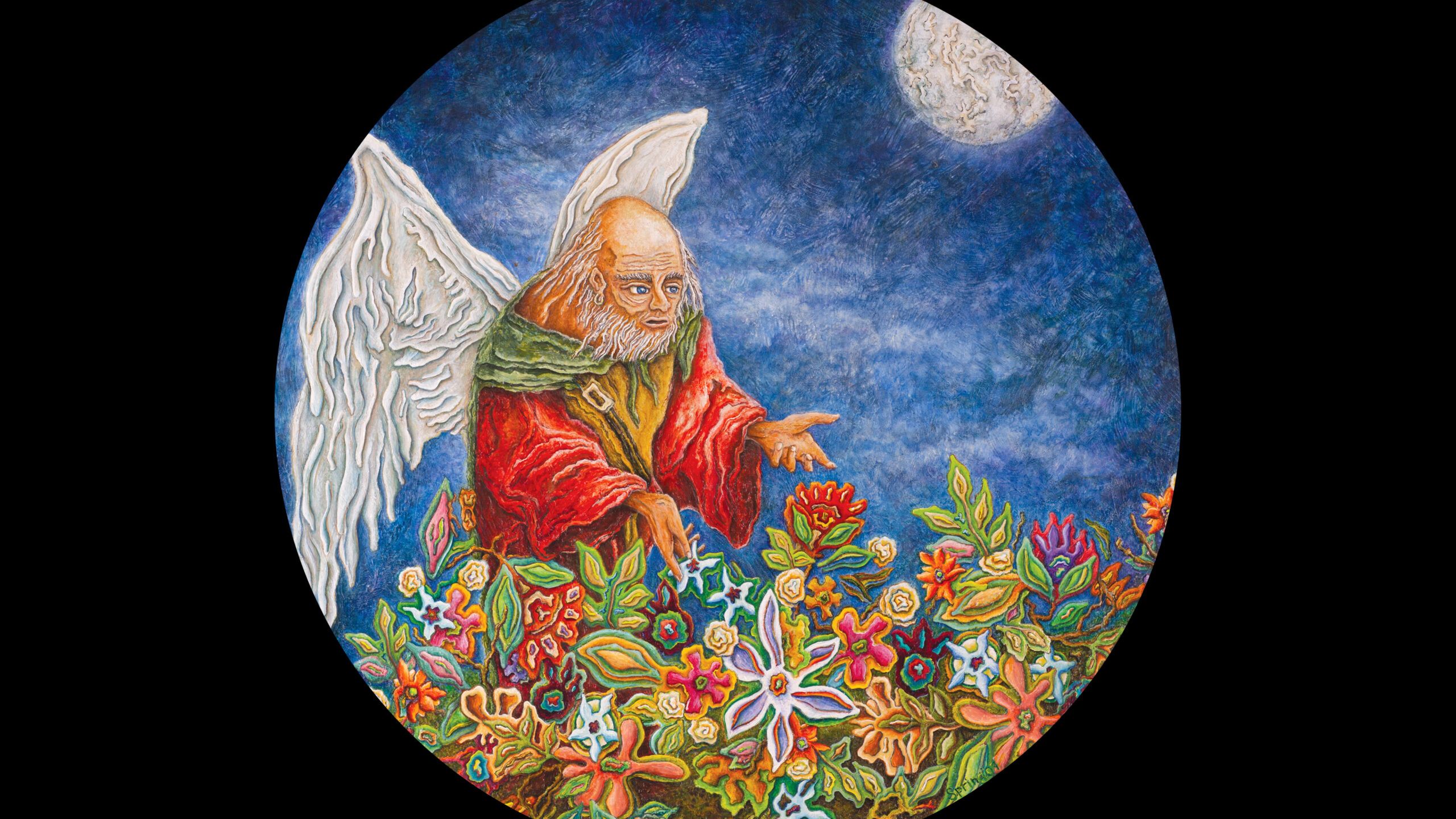
The Old Optimist
Crafted on wood in a circular composition, The Old Optimist serves as a visionary self-portrait. Frank motivated by a realization he had never encountered a portrayal of an aged Angel, set out to capture the profound essence of growing older, marked by the wisdom gained through life’s trials. Frank sought to convey a universal message – that we are all chosen by a higher power throughout our existence, with aging signifying not weakness but a repository of wisdom, empathy, and nurturing capabilities.
In this poignant image, the Angel engages in what seems to be a conversation with flowers. The diverse and expressive floral tableau mirrors the intricacies of Frank’s daily life. Having played a nurturing role for numerous individuals and organizations, each with its distinct mission, Frank generously shared his guidance, expertise, time, and resources. His earnest desire was for everyone to realize their inherent potential, to be seen authentically, and, above all, to be fully appreciated.
Frank’s artistic repertoire often embraced themes of gardens and florals, with gardens symbolizing the seasons of life and the reliable rejuvenation of spring. The symbolism extended beyond art, manifesting in Frank’s personal passion for floral gardening evident on his intimate Chelsea deck. Here, amidst the vibrant hues he nurtured, Frank found a reflection of hope, renewal, and the perpetual cycle of birth – a testament to his belief in the enduring beauty that arises from tending to life’s delicate and resilient blooms.
This painting is in a private collection.
Shared Interpretations
Frank referred to this painting as a “future self-portrait”. As in The Aspirant, the subject is winged, but in this image the wings appear to be organic to the figure (as of an angel), not merely strapped on as a temporary means of locomotion, albeit to a higher plane. This figure is older, and rather than simply aspiring, he has taken on the role of healer and nurturer, carefully tending his garden.
The subject’s eyes are striking, as are the eyes in all of Frank’s paintings. He is gazing intently outward, not directly at the flowers in front of him. His eyes, which are very austere, seem to reflect his appreciation of the deep distress of the world. Yet his optimism is conveyed in the love and care with which he tends his flowers. The overall impression conveyed is that of a deeply benign presence.
As a self-portrait, it depicts Frank as someone who wants to give, to nurture and to protect. Though not quite an angel (perhaps that is why he called it a future self-portrait) Frank did possess these excellent qualities in abundance, as so many people who remember him can attest.
Tom H.